

The Development of IKN and the Agenda for Regional Integration
The development of Indonesia’s new capital, Nusantara (IKN), should be assessed through a broader public policy perspective rather than merely by observing individual institutions’ decisions about where to locate their offices. A decision by an institution to retain its headquarters in Jakarta, for example, does not automatically indicate that IKN has lost its relevance or that the strategic direction of the project has weakened. Each institution operates under a distinct mandate, operational requirements, budgetary considerations, and organizational characteristics. Therefore, administrative decisions of this nature should be understood within their institutional context rather than immediately interpreted as a reflection of the state’s overall policy direction.
In this context, the Indonesia Deposit Insurance Corporation (Lembaga Penjamin Simpanan or LPS) decision to pursue a permanent office in Jakarta can be understood as part of its organizational management considerations. LPS has explained that the decision relates to long-term institutional needs, operational effectiveness, and budget efficiency. It has also reaffirmed that this decision does not represent a withdrawal of its support for IKN development. Accordingly, the more relevant question is not simply why an institution has chosen to maintain its office in Jakarta, but how the state manages the institutional transition and the development of its new capital in a realistic, measurable, and consistent manner.
The relocation of the capital should not be understood as requiring the simultaneous transfer of all national economic activities to a single location. Government functions, business activities, financial centers, industry, trade, and service networks may remain geographically distributed. The continued presence of major economic activities in Jakarta does not automatically contradict the development of IKN as Indonesia’s new administrative center. What matters is whether this division of functions is deliberately designed, properly coordinated, and supported by policy certainty.
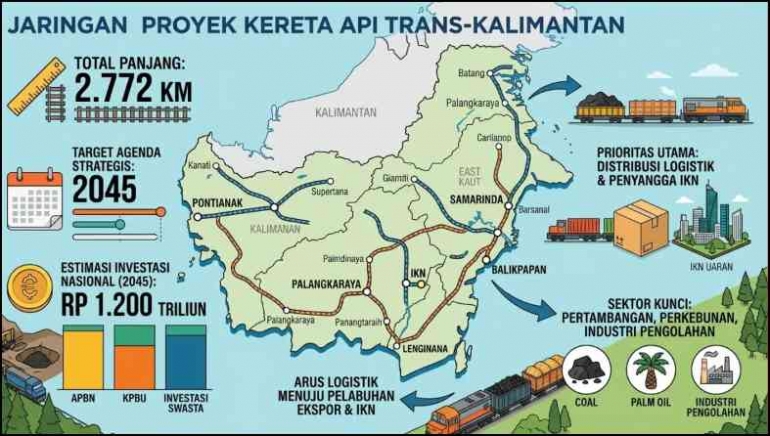
Furthermore, IKN should not be viewed as an isolated development project in the middle of Kalimantan. Its broader significance should be assessed in relation to regional connectivity, logistics distribution, production centers, and economic integration across the island. One relevant development is the proposed expansion of the railway network across Kalimantan. On November 25, 2026, Indonesia’s Ministry of Transportation announced the signing of a Framework Agreement between China Railway Engineering Corporation (CREC) and PT Nusa Investama Utama as an initial step toward developing a railway network in Kalimantan. The initial phase reportedly includes a 162-kilometer double-track railway, primarily intended for coal transportation. The government has also expressed the expectation that long-term planning will consider connectivity to Central Kalimantan, South Kalimantan, and other provinces.
This plan matters not merely because it involves railway construction, but because it indicates a potential direction for infrastructure development that could connect production centers, industrial areas, logistics hubs, ports, and regional growth centers. In a broader context, such connectivity could strengthen IKN’s position within Kalimantan’s regional economic network rather than leave it as an isolated administrative area. The relationship between IKN and cross-regional transportation infrastructure is therefore complementary: the development of a new capital can generate new centers of demand and economic activity, while regional infrastructure can expand accessibility, markets, the movement of goods, and economic opportunities that support the area’s long-term viability.
This direction is also reflected in the Directorate General of Railways’ discussion in June 2026 on updating the Masterplan for the Kalimantan Railway Network. The study covers spatial planning, passenger and freight demand, technical, financial, and economic feasibility, as well as alternative financing mechanisms beyond the state budget. The government had previously announced plans to develop a railway network extending up to 2,772 kilometers across Kalimantan. However, this figure should be understood as a planning target, not as the length of railway infrastructure already completed or fully secured through investment commitments. This distinction is important to recognize the potential of the development agenda without overlooking the actual stages of implementation.
From a regional development perspective, railway connectivity could generate benefits extending beyond the interests of a single city or province. An integrated transportation network has the potential to reduce logistics costs, improve commodity distribution, strengthen links between production areas and ports, and expand public access to service centers and economic opportunities. Nevertheless, these benefits will not materialize automatically. The government must ensure that railway routes are consistent with spatial planning, economic feasibility, environmental protection, safety standards, community needs, and sustainable financing. The development of the network should also avoid excessive dependence on a single commodity, allowing the infrastructure to support economic diversification and public mobility over the long term.
The assessment of IKN should likewise not be limited to the number of government offices that have relocated. Institutional relocation is certainly an important component of capital development, but it is not the sole indicator of success. Basic infrastructure, connectivity, public service quality, workforce availability, regulatory certainty, economic activity, and the capacity to attract productive investment are far more substantive indicators. Development progress should be assessed against established stages and targets. For instance, the Nusantara Capital Authority reported that, as of November 12, 2026, the average physical progress of construction in the legislative zone and its road infrastructure stood at 25.40 percent, while the judicial zone had reached 32.83 percent. These figures indicate that construction is ongoing and that the area has not yet matured into a fully functioning urban ecosystem.
The same principle applies when assessing private investment. Investors do not make decisions solely on the basis of a region’s political status as a national capital. They also consider legal certainty, market demand, workforce availability, accessibility, infrastructure, supplier networks, public service quality, and long-term profitability. Therefore, private investment that has yet to meet expectations does not automatically demonstrate that IKN lacks economic potential. However, the government cannot rely indefinitely on the argument that investment takes time. It must demonstrate that public infrastructure development is creating the conditions necessary to attract productive investment, expand employment opportunities, and sustain economic activity.
From the perspective of fiscal governance, changes in budget allocations should also be interpreted proportionately. Institutional budget proposals, indicative government allocations, annual budget decisions, and actual expenditure are distinct stages of the budgeting process. An adjustment to a particular budget item does not necessarily mean that the overall policy has been abandoned. Nevertheless, the government remains responsible for explaining its financing strategy, annual priorities, division of responsibilities, and implementation targets. Transparency is essential to distinguish rational budget adjustments from policy changes that may create uncertainty.
Ultimately, IKN should be understood within the broader framework of national development transformation. The concentration of economic activity in Java, Jakarta’s ecological pressures, regional development disparities, and the need to create new growth centers outside Java are structural challenges that cannot be resolved merely by relocating the seat of government. IKN offers one policy instrument for addressing these challenges. However, its broader impact will depend on whether capital development proceeds alongside stronger regional connectivity, the expansion of production centers, improved logistics capacity, and greater economic integration across regions. In this context, the proposed cross-Kalimantan railway network represents one example of a complementary development direction that deserves attention, although its implementation must still be assessed in terms of feasibility, financing, and measurable progress.
For this reason, public debate about IKN should not become trapped in symbolic interpretations of individual institutional decisions. Criticism of IKN development remains necessary, but meaningful criticism must examine actual achievements, costs, effectiveness, transparency, and policy outcomes using verifiable evidence. Similarly, support for IKN must be accompanied by demands for accountability, ensuring that the project succeeds not only as a physical construction undertaking but also as a transformation of governance and national development distribution.
The success of IKN does not need to be demonstrated by requiring every institution to relocate its offices simultaneously. It should instead be measured by the state’s ability to establish a functioning administrative center, a livable urban environment, a productive economic ecosystem, and regional connectivity that strengthens territorial and economic integration. Ultimately, the success of IKN should be measured not only by what is built within the capital area, but also by the benefits it generates for the wider regions connected to it.