

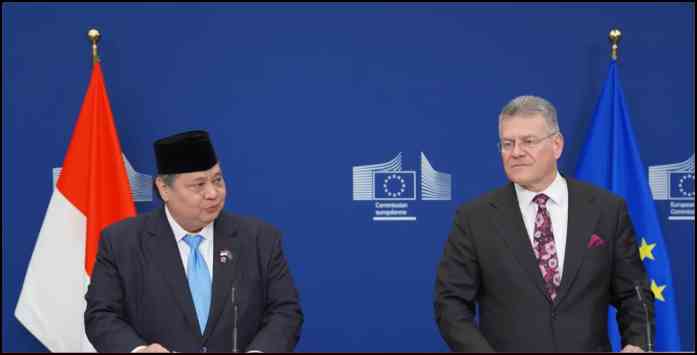
IEU-CEPA: Building Balance
There is a fundamental principle that should guide our understanding of international trade cooperation: trade between countries does not require equality in commodities, industrial capacity, or market structures. International trade exists precisely because countries possess different economic capabilities, comparative advantages, needs, and interests. What must be established is not uniformity in economic positions, but a balanced relationship built upon mutually recognized standards, rules, rights, obligations, and mechanisms for resolving disputes.
From this perspective, the Indonesia-European Union Comprehensive Economic Partnership Agreement (IEU-CEPA) should not be assessed solely by asking whether Indonesia can export as much as European countries, whether its industrial structure is already comparable to Europe’s, or whether all Indonesian businesses possess equivalent capabilities. Such an assessment rests on an incomplete understanding of international trade. Countries do not enter trade agreements because they possess identical economic capabilities. They do so because they recognize the mutual benefits of managing their different capacities and interests through an agreed framework of cooperation.
Balance in international trade does not mean identical outcomes. It means establishing mutually agreed rules that allow each party to pursue and obtain reasonable benefits. This principle matters because countries with different levels of industrial development can still establish mutually beneficial trade relations, provided that their rights and obligations are clearly defined, their commitments are enforceable, and their respective policy spaces are managed proportionately.
In the theory of comparative advantage introduced by David Ricardo, international trade enables countries to benefit from specialization based on relative opportunity costs, rather than relying exclusively on absolute advantages or the ability to produce every commodity independently (Ricardo, 1817). This principle offers an important insight: countries do not need to excel in the same sectors to benefit from trade.
Indonesia and the European Union have different economic structures. Indonesia possesses a substantial natural resource base, a large domestic market, a significant workforce, and growing potential in manufacturing and downstream industries. The European Union, meanwhile, has established strengths in several areas, including advanced technology, high-value manufacturing, services, and products supported by sophisticated industrial standards. These differences do not automatically indicate a disadvantageous relationship. Rather, they create opportunities for economic complementarity.
Therefore, the success of IEU-CEPA should not be measured by whether Indonesia achieves the same commodity composition or market structure as Europe. A more relevant measure is whether Indonesia can optimize its comparative advantages, expand its productive capabilities, and increase domestic value creation through this trade relationship.
International trade does not take place in a space entirely free from political and economic interests. Every country brings its own national priorities, industrial structures, development objectives, and bargaining power. Trade cooperation therefore requires rules that can be mutually accepted to manage these differences.
Within the multilateral trading system, principles such as non-discrimination, transparency, legal certainty, and commitments to trade concessions provide important foundations. However, bilateral and regional trade agreements can also establish specific arrangements, including tariff reduction schedules, exemptions for sensitive products, rules of origin, and trade safeguard mechanisms.
Consequently, balance does not have to be achieved through an exchange of commodities with identical values or volumes. It is established through mutual recognition of each party’s rights and obligations, together with compliance with the standards and procedures agreed upon.
This perspective is consistent with Robert Keohane’s institutionalist argument. International institutions help states manage divergent interests through rules, information, and mechanisms of cooperation that reduce uncertainty (Keohane, 1984). In the context of IEU-CEPA, the agreement’s strategic value lies in establishing a more predictable institutional framework for economic relations, rather than in assuming that both parties must possess equivalent economic capabilities from the outset.
Nevertheless, the existence of rules alone does not automatically guarantee balance. The quality of an agreement also depends on each party’s ability to advance its interests during negotiations, implement its commitments, and use available mechanisms when disputes arise.
The concern that improved market access does not automatically produce an export boom is fundamentally valid. However, this concern should not be used to diminish the value of market access itself.
In international trade, market access is one of the essential conditions for expanding commercial activity. It provides greater tariff certainty and a legal framework that allows exporters to plan investment, production, and distribution. Nevertheless, actual export performance continues to depend on industrial capacity, product quality, productivity, financing, logistics, and the ability to meet consumer demand.
In other words, no trade agreement can substitute for the domestic work required to strengthen an economy. An agreement creates opportunities and external certainty, while governments and businesses remain responsible for translating those opportunities into productive economic activities.
It is therefore inappropriate to measure an agreement’s success solely by how quickly exports increase after its signing. Trade agreements operate over a longer time horizon. Businesses need time to adjust production standards, establish distribution networks, obtain certification, and identify commercial partners. Investment also does not necessarily generate new production capacity within a short period.
A more rational approach is to regard IEU-CEPA as a long-term instrument for expanding economic opportunities, rather than as a promise that Indonesian exports will immediately surge once the agreement is signed.
Technical standards, environmental requirements, product safety regulations, and supply-chain traceability are often perceived as barriers for developing countries. Such concerns have a legitimate basis, particularly when compliance costs place disproportionate burdens on small and medium-sized enterprises.
However, standards also serve a broader purpose. In international trade, they help establish trust, ensure product quality, protect consumers, and create greater certainty for cross-border transactions. Countries that can meet international market standards ultimately gain opportunities to access a wider range of markets.
Indonesia’s challenge, therefore, is not to reject agreed standards, but to ensure that their implementation remains transparent, consistent, proportionate, and non-discriminatory. If a requirement is imposed unilaterally or becomes a disguised barrier to trade, a country should be able to use consultation and dispute settlement mechanisms in accordance with the relevant agreement.
At the same time, the government must strengthen domestic capabilities so that businesses do not face international standards alone. Support for certification, testing laboratories, production technology, financing, and export assistance should form part of Indonesia’s strategy for utilizing trade agreements.
International standards should therefore not be treated merely as external burdens. They can also become drivers of industrial modernization and improvements in national production quality.
The presence of Southeast Asian countries that already have trade agreements with the European Union certainly creates competition. However, this does not mean that Indonesia’s opportunities have already been exhausted.
In international trade, a country’s competitive advantage is not determined solely by when it signs an agreement. Its ability to utilize the available facilities is equally important. Factors such as production scale, proximity to raw materials, infrastructure quality, logistics efficiency, policy stability, and supplier networks all contribute to competitiveness.
Indonesia also does not need to replicate every aspect of another country’s trade strategy. Its economic characteristics are shaped by a distinct geography, resource base, domestic market, and development requirements. Therefore, its strategy for utilizing IEU-CEPA must be designed around its own national interests and competitive advantages.
Furthermore, the agreement with the European Union can form part of Indonesia’s broader strategy to diversify its international economic relations. Such diversification is important to reduce excessive dependence on a single region, group of trading partners, or commodity category. In an increasingly competitive global economy, expanding the range of economic partners is itself a way of strengthening national bargaining power.
One recurring concern surrounding trade agreements is the entry of foreign products that could put pressure on domestic industries. This concern deserves a rational response, rather than an assumption that every imported product represents a threat to economic sovereignty.
Imports can form part of the industrial development process. Raw materials, capital goods, technology, and production components from abroad can help strengthen domestic industrial capacity. Conversely, if imports of finished products increase without corresponding improvements in national production capabilities, external dependence may become a structural problem.
The central issue, therefore, is not whether to choose openness or protection as absolute alternatives. What is required is the ability to manage openness strategically. The state must distinguish between products that strengthen domestic productive capacity and those that may place unprepared domestic sectors under excessive competitive pressure.
This is where transitional periods, exemptions for sensitive products, safeguard provisions, industrial policies, and competitiveness programmes become important. These instruments do not represent a rejection of free trade. Rather, they are part of the process of managing the consequences of market liberalization.
Market openness and national interests are therefore not necessarily contradictory. They can reinforce one another when the government has a clear industrial strategy and the institutional capacity to manage trade commitments consistently.
IEU-CEPA should not be evaluated solely through short-term export and import figures. The trade balance is one relevant indicator, but it is not the only measure of successful economic cooperation.
Trade agreements can generate benefits through increased investment, expanded supplier networks, technology access, knowledge transfer, job creation, manufacturing development, and market diversification. Some of these benefits may not be immediately reflected in export figures during the first year of implementation.
From a development perspective, the more important question is whether the agreement helps Indonesia improve its position in global value chains. Will Indonesia remain primarily a supplier of raw materials, or will it expand its contribution to value-added manufacturing? Will domestic companies remain lower-tier suppliers, or will they gain access to production networks with higher value creation? Will improved market access generate investment that strengthens national capabilities, or merely increase trade flows without producing structural economic change?
These questions provide a more substantive framework for evaluating success. Ultimately, the benefits of IEU-CEPA will depend on Indonesia’s ability to connect trade policy with industrial policy, education and workforce training, infrastructure, technology, and investment.
One fundamental principle must be understood when examining trade relations between countries: states do not need to possess equal economic power to establish mutually beneficial cooperation. What they need is a willingness to recognize their differences, agree on common rules, fulfil their commitments, and responsibly